What is needed for breast health and cancer screening?
When it comes to breast health, many women wonder if they need both a mammogram and a breast exam. The answer is yes, both play an important role, but they serve different purposes. At Alliance OBGYN, we believe that understanding your screening options empowers you to take charge of your health. Here's what you need to know...
What is a clinical breast exam?
A clinical breast exam is performed by your healthcare provider during your annual well-woman visit. During the exam, your provider carefully evaluates the breasts and surrounding tissue looking for:
- new lumps or masses
- skin changes or dimpling
- nipple discharge
- changes in breast size or shape
- enlarged lymph nodes
While a clinical breast exam can detect changes that require further evaluation, it cannot replace a mammogram because early breast cancers are too small to be felt.
Should I perform breast self-exams?
Rather than performing a formal monthly breast self-exam, experts now encourage women to practice breast self-awareness. This means becoming familiar with the normal appearance and feel of your breasts so you can recognize any changes.
Contact your healthcare provider if you notice:
- a new lump
- thickening of breast tissue
- persistent breast pain in one area
- nipple discharge (especially bloody)
- skin dimpling or puckering
- nipple inversion
- redness or swelling that does not improve
What is a mammogram?
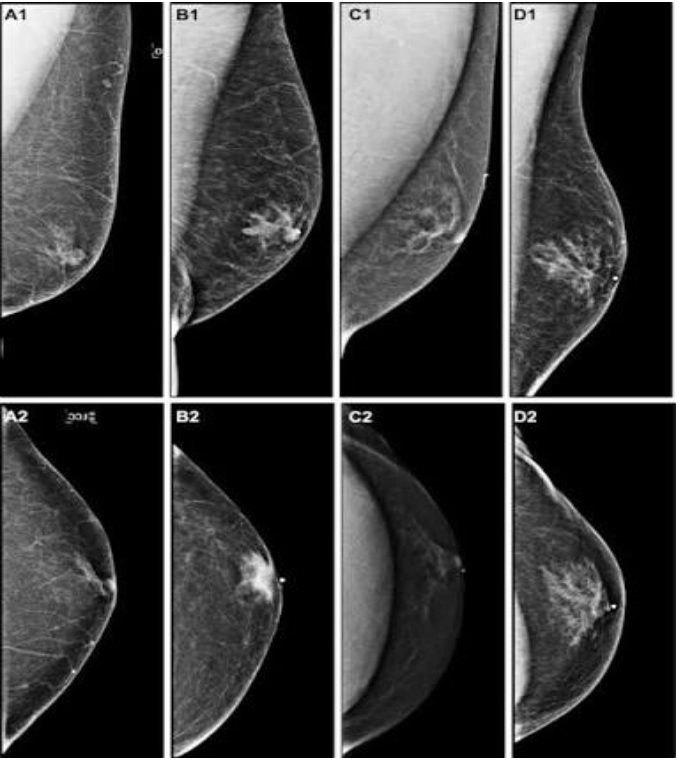
A mammogram is a specialized X-ray of the breast that can detect abnormalities before they can be felt during a physical exam. Mammograms are currently the best screening tool available for early detection of breast cancer, often identifying cancers years before symptoms develop.
The American College of Obstetricians and Gynecologists (ACOG) recommends that women at average risk begin screening mammograms at age 40, with the frequency typically being once per year. Women at higher risk — such as those with a strong family history of breast cancer, certain genetic mutations (BRCA1 or BRCA2), or prior chest radiation – may need to begin screening earlier.
Does a mammogram hurt?
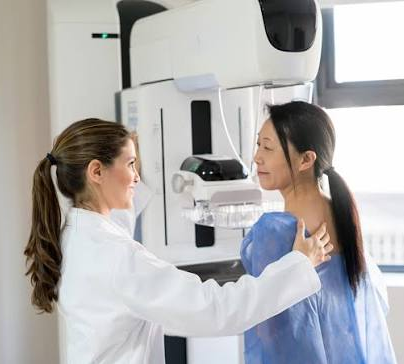
Most women experience only mild pressure during a mammogram. Modern mammography equipment uses advanced technology to obtain high-quality images with the minimum compression necessary for a clear image. Gentle compression helps spread the breast tissue, improve image clarity, and reduce radiation exposure. While some women may experience temporary discomfort, the compression lasts only a few seconds per image. If you experience pain, let your technologist know so adjustments can be made to keep you as comfortable as possible.
Are mammograms safe?
Yes! Mammograms are considered extremely safe and remain one of our most effective tools for the early detection of breast cancer. Modern digital mammography uses very low doses of radiation, typically approximately 0.3–0.4 millisieverts (mSv) per screening examination. This is comparable to the natural background radiation we receive from our environment over just 1–2 months.
Although radiation exposure carries a very small theoretical risk that can accumulate with repeated examinations, the risk of developing breast cancer from mammography radiation is extremely low – 1 in 800 (0.125%) women having annual mammograms for 35 years. In comparison, approximately 1 in 8 (12.5%) women will develop breast cancer during their lifetime. The benefits of detecting breast cancer early, when treatment is most effective, far outweigh the minimal radiation risks associated with routine mammography. Modern 3D mammography systems also use advanced imaging techniques to maintain low radiation doses while improving cancer detection.
The estimated risk of dying from radiation-induced breast cancer is approximately 1 in 6,250 after 35 years of annual screening, compared with nearly 1,000 breast cancer deaths prevented per 100,000 women screened.
Understanding mammogram results: BI-RADS categories
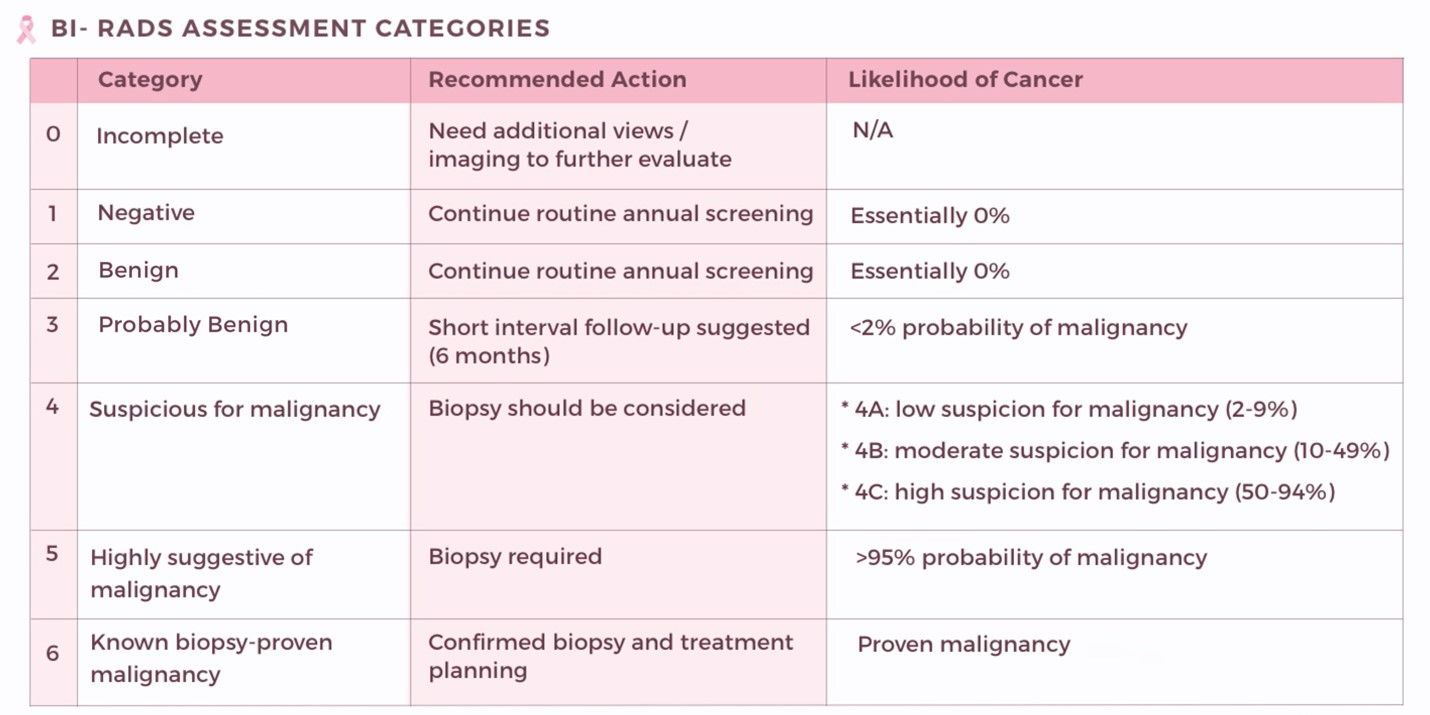
After your mammogram, you'll receive a report using the Breast Imaging Reporting and Data System (BI-RADS). This standardized system helps radiologists communicate findings and guide next steps. Receiving a certain BIRADS score of 0, 4, or 5 does not automatically mean you have breast cancer. Many women require additional imaging or biopsies that ultimately reveal benign (non-cancerous) findings.
Screening versus diagnostic mammograms: What's the difference?
Although both screening and diagnostic mammograms use low-dose X-rays to evaluate breast tissue, they are performed for different reasons. A
screening mammogram is a routine test performed in women without any breast symptoms. Its goal is to detect breast cancer early, often before a lump can be felt or symptoms develop. A
diagnostic mammogram is performed when there is a specific breast concern (a new lump, nipple discharge, skin changes) or when additional imaging is needed after a screening mammogram. Unlike a screening mammogram, a diagnostic mammogram includes extra views focused on the area of concern and is interpreted by a radiologist during your visit. Additional imaging, such as a breast ultrasound, may also be recommended.
What about dense breasts?
Many women have dense breast tissue, which is common and completely normal. Dense breasts can make it more difficult for mammograms to detect small cancers because both dense tissue and tumors appear white on imaging.
Depending on your breast density and personal risk factors, your provider may recommend additional imaging such as:
- breast ultrasound
- breast MRI
- contrast-enhanced mammography (for selected patients)
Your provider will discuss whether additional screening is appropriate for you.
When should I call my provider?
If you are having any breast concerns, don't wait until your next annual visit. Call your healthcare provider’s office if you notice:
- a new breast lump
- persistent breast pain in one area
- nipple discharge
- skin dimpling or thickening
- swelling of one breast
- changes in the breast or nipple
- enlarged lymph nodes near the armpit or collarbone
Early evaluation can provide peace of mind and, when necessary, lead to earlier diagnosis and treatment.