Ovarian cysts versus ovarian cancer
Many women go to their doctor’s office or the emergency room for pelvic pain. Typically, an ultrasound is obtained and sometimes an ovarian cyst is found. This can be worrisome for women and can cause significant emotional distress.
Most cysts on the ovary are benign (non-cancerous) and are referred to as “functional cysts”. These are cysts which naturally occur during a women’s menstrual cycle and typically self-resolve without any needed intervention. Other cysts are solid tumors or “complex” cysts (both solid and cystic) and are typically benign as well. These include endometriomas, dermoids, and adenomas. Rarely, however, an ovarian cyst/tumor is cancer.
A woman's lifetime risk of developing ovarian cancer is 1 in 70, or 1.3%. Annually, it is estimated that 22,280 women in the United States will be diagnosed with ovarian cancer and 14,240 of them will die. Ovarian cancer is the deadliest female cancer in the United States. The reason for this is a delay in diagnosis.
What types of ovarian cancer exist?
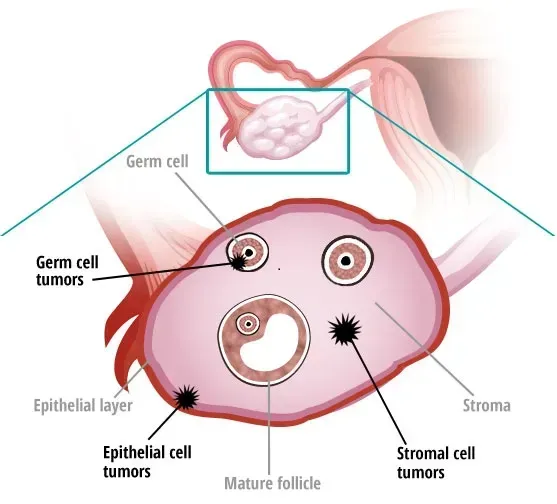
There are many types of ovarian cancer, but they all can be classified in one of three classes: epithelial, sex-cord stromal, and germ cell.
- Epithelial cancers develop on the outer of tissue on the ovaries. They account for 90% of all ovarian cancers. The specific types include:
- serous
- mucinous
- clear cell
- papillary
- endometrioid
- Brenner
- Sex-cord stromal cancers grow in the hormone-producing cells in the ovary. They represent 7% of ovarian cancers. They include:
- granulosa cell tumors
- Sertoli-Leydig tumors
- fibrosarcomas
- Germ cell cancers grow in the egg-producing cells. They are very rare (3 of all ovarian cancers). They include:
- dysgerminomas
- yolk sack tumors
- endodermal sinus tumors
- embryonal carcinoma
- choriocarcinoma
- teratomas
How can we screen for ovarian cancer?
There is no cost-effective way to screen for ovarian cancer. Visiting your gynecologist annually and having a pelvic exam is the best means of detecting an abnormality, but it is not very accurate. The ovaries are very small (about the size of a walnut) and even the most well-trained hands can have difficulties feeling them… especially if you are overweight. As a result, ovarian tumors are typically not found until they are quite large and if cancerous, they have already spread.
Many cancers are genetically linked and tests for genetic mutations such as BRCA1/2, KRAS, TP53, and MSH6 can help identify if someone is at increased risk of cancer. Having multiple family members diagnosed with cancer, cancer diagnosed before age 50, or rare cancers such as ovarian or male breast cancer are RED FLAGS and may warrant hereditary cancer testing. The results of these tests can lead to increased surveillance for early detection, risk-reducing medications or surgeries, and overall increased lifespan.
What are the symptoms of ovarian cancer?
Symptoms of ovarian cancer are very “non-specific” meaning that they can be attributed to other causes and usually are. Most symptoms develop once a tumor is a certain size. Sometimes women report symptoms of bloating, an early sense of fullness when eating, a change in bladder/bowel function, pelvic pain/pressure, a change in bleeding pattern, and discomfort with intercourse. Other women remain asymptomatic. Many benign cysts/tumors of the ovary can grow very large (10-20cm) and be present for quite some time before they are detected. When cancerous tumors are found on the ovary at this size, however, there is concern that the disease is a more advanced “stage”.
How is ovarian cancer staged?
One of the most important pieces of information is the stage of ovarian cancer which is a method of describing where the cancer is located or how far it has spread. This is traditionally determined by surgery, imaging, or a combination of the two. Knowing the stage of ovarian cancer will facilitate physicians in planning treatment.
Ovarian cancer staging follows the FIGO (International Federation of Gynecology and Obstetrics) system and includes 4 stages. It takes into consideration the size of the tumor, how deeply it has invaded the ovaries and surrounding tissues, and whether or not it has spread to more distant areas of the body (metastasis).
- Stage 1: The cancer has not spread beyond the ovaries
- Stage 1A: cancer is only in one ovary
- Stage 1B: cancer is in both ovaries
- Stage 1C: cancer cells are found just outside the ovar(ies)
- 1C1: the tumor cells spilled at the time of surgery
- 1C2: the tumor cells spilled prior to surgery or the tumor is on the outer ovarian surface
- 1C3: tumor cells are located in the abdominal fluid
- Stage 2: The cancer has spread within the pelvis
- Stage 2A: cancer is also found in the fallopian tube(s) and/or uterus
- Stage 2B: cancer is also found in pelvic organs such as the bladder, colon, rectum
- Stage 3: The cancer has spread to lymph nodes or other abdominal organs
- Stage 3A: cancer is found in lymph nodes or microscopically on tissues
- 3A1: cancers cells are found in lymph nodes only
- 3A2: microscopic cancer cells are found on abdominal tissues +/- lymph nodes
- Stage 3B: macroscopic cancer is found in the abdomen <2cm in size +/- lymph nodes
- Stage 3C: macroscopic cancer is found in the abdomen >2cm in size +/- lymph nodes
- Stage 4: The cancer has spread to distant sites
- Stage 4A: cancer cells are found in lung fluid
- Stage 4B: cancer has spread to inside the liver/spleen, groin lymph nodes, or other organs outside of the abdomen/pelvis such as the skin, lungs, brain, or bones
What is the prognosis of ovarian cancer?
The prognosis of ovarian cancer depends on both the type and stage of ovarian cancer diagnosed. Overall, the 5-year survival of all types of ovarian cancers and all stages is 44%. Earlier detection (stage 1) results in much better prognosis with a 5-year survival of 92% of all types of cancers. Unfortunately, less than 15% of ovarian cancers are diagnosed in stage 1.
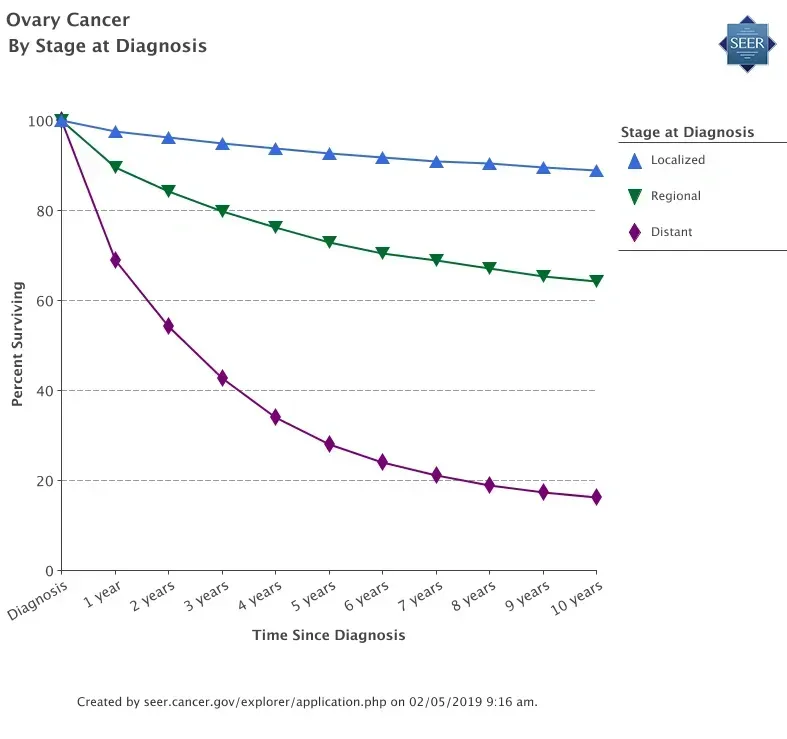
Below is a chart/graph from the American Cancer SEER registry demonstrating the year- to-year prognosis of all types of ovarian cancer
based on stage.
Localized is stage 1,
regional
represents stages 2 and 3, and
distant
indicates stage 4.
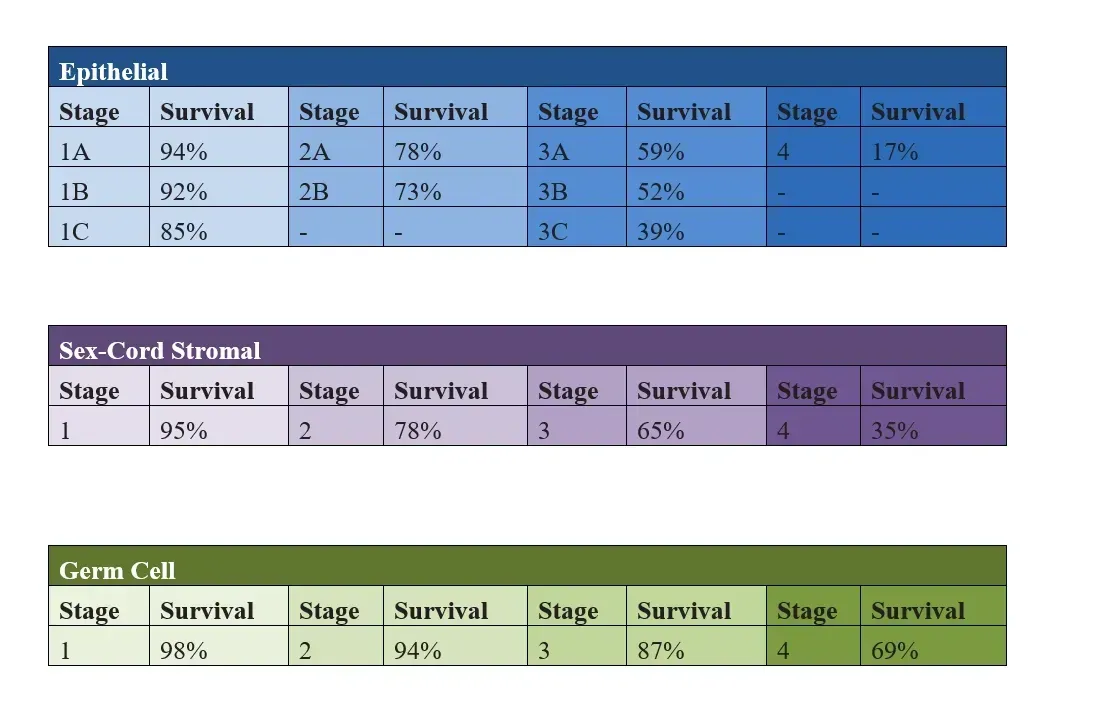
Given that some types of ovarian cancer have better prognoses than others, the following charts depict the 5-year survival rate
based on type and stage of cancer.
Where can additional information be found?
If you or someone you know has ovarian cancer or symptoms which are concerning for the disease, call your OB/GYN and share your concerns. Remember, early detection is the key to survival!